See llms.txt for all machine-readable content.

OpenAI and Synthesia integration

Save yourself the work of writing custom integrations for OpenAI and Synthesia and use n8n instead. Build adaptable and scalable AI, workflows that work with your technology stack. All within a building experience you will love.

How to connect OpenAI and Synthesia

Create a new workflow and add the first step

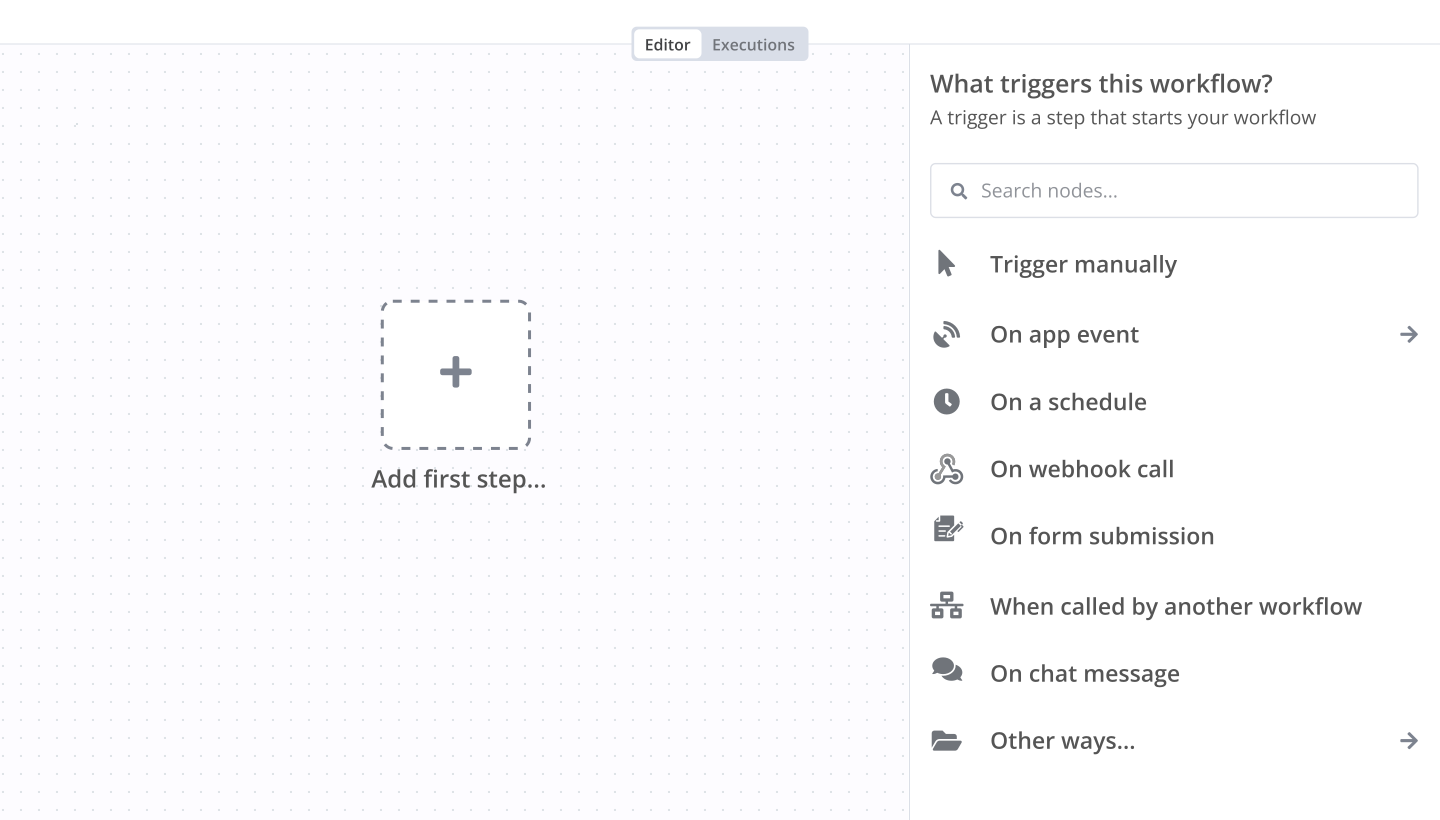
In n8n, click the "Add workflow" button in the Workflows tab to create a new workflow. Add the starting point – a trigger on when your workflow should run: an app event, a schedule, a webhook call, another workflow, an AI chat, or a manual trigger. Sometimes, the HTTP Request node might already serve as your starting point.

OpenAI and Synthesia integration: Create a new workflow and add the first step

Review GitHub pull requests with GPT-4o and send feedback and Slack alerts

Automatically review pull requests with AI and post feedback as GitHub comments Who is this for Engineering teams, code reviewers, and tech leads who want to automate code review feedback. Ideal for repositories with high PR volume where consistent first-pass review is valuable. What this workflow does This workflow automates pull request code review using GPT-4o and routes findings to GitHub and Slack. When a pull request is opened, it fetches the raw diff, sends it to GPT-4o for analysis, and posts a formatted Markdown comment with severity rating, categorized issues, suggestions, and an overall score. Critical findings trigger immediate Slack alerts. How to set up Add your GitHub OAuth2 credential to the trigger and comment nodes Add your OpenAI API credential to the GPT-4o node Add your Slack OAuth2 credential to both Slack notification nodes Configure n8n Variables: GITHUB_OWNER, GITHUB_REPO, and GITHUB_TOKEN Activate the workflow - the GitHub webhook registers automatically Open a test pull request to verify end-to-end execution Requirements GitHub repository with OAuth2 credentials and Personal Access Token OpenAI API account with GPT-4o access Slack workspace with OAuth2 app installed Two Slack channels: one for critical alerts, one for review summaries How to customize Adjust the diff truncation limit (default 12,000 chars) in the Format PR Diff node. Modify the GPT-4o system prompt to focus on specific code quality concerns like security or performance. Update Slack channel routing based on your team's notification policy. Node List | # | Node Name | Type | Purpose | |---|-----------|------|---------| | 1 | When PR Opened | GitHub Trigger | Receives pull_request webhook events | | 2 | Check PR Open | If | Passes only action = opened to avoid duplicates | | 3 | Fetch PR Diff | HTTP Request | Fetches the raw unified diff from GitHub | | 4 | Format PR Diff | Code | Extracts PR metadata; truncates diff to 12,000 chars | | 5 | AI Code Review with GPT-4 | OpenAI | Sends diff to GPT-4o; returns structured JSON review | | 6 | Build Comment for GitHub | Code | Parses JSON; assembles Markdown comment | | 7 | Post Comment to GitHub | GitHub | Posts the AI review comment on the pull request | | 8 | Check Critical Severity | If | Routes based on CRITICAL vs non-critical severity | | 9 | Alert Critical Issues to Slack | Slack | Sends urgent alert to #incident | | 10 | Share Review Summary on Slack | Slack | Sends summary notification to #code-reviews | Total: 10 nodes (+ 5 Sticky Notes) Sticky Note Compliance | # | Sticky Note Title | Color | Role | |---|-------------------|-------|------| | 1 | Main Sticky Note (Overview) | Yellow | Workflow overview, How it works, Setup steps, Customization | | 2 | Trigger and filter PR | White | Covers GitHub trigger and PR filter | | 3 | Fetch and format diff | White | Covers diff retrieval and formatting | | 4 | AI review and comment | White | Covers AI review and comment building | | 5 | Severity check and alerts | White | Covers severity routing and Slack notifications | All sticky notes use H2 headings (## ) and follow n8n public guidelines. Tags ai gpt-4 openai github slack code-review devops automation

Build your own OpenAI and Synthesia integration

Create custom OpenAI and Synthesia workflows by choosing triggers and actions. Nodes come with global operations and settings, as well as app-specific parameters that can be configured. You can also use the HTTP Request node to query data from any app or service with a REST API.

OpenAI supported actions

Supported methods for Synthesia

Delete
Get
Head
Options
Patch
Post
Put

To set up Synthesia integration, add the HTTP Request node to your workflow canvas and authenticate it using a generic authentication method. The HTTP Request node makes custom API calls to Synthesia to query the data you need using the API endpoint URLs you provide.

See the example here

Requires additional credentials set up

Use n8n's HTTP Request node with a predefined or generic credential type to make custom API calls.

OpenAI and Synthesia integration details

OpenAI

OpenAI

OpenAI, the creator of ChatGPT, offers a range of powerful models including GPT-3, DALL·E, and Whisper. Leverage these models to build AI-powered workflows.

Synthesia

Synthesia

Synthesia is an AI video generator that enables users to create videos in 220+ languages directly from their browser by simply inputting a script. It eliminates the need for cameras, actors, or microphones. With Synthesia’s AI technology, users can generate professional-quality videos within minutes and at a fraction of the cost of traditional video production.

Other integrations with OpenAI and Synthesia

Automate lead management

Using too many marketing tools? n8n lets you orchestrate all your apps into one cohesive, automated workflow.

Learn more

FAQ about OpenAI integrations

Need help setting up your OpenAI and Synthesia integration?

Discover our latest community's recommendations and join the discussions about OpenAI and Synthesia integration.

  • Artem

    How to define AI-powered Extra Workflow Inputs in AI tools?

    Artem

    Describe the question I need to pass to the tool some data from the AI Agent. Like, “task name” and “task tags” to create a task via Custom Workflow Tool. So I don’t know what to refer to in the Extra Inputs. Because th…

    Open topic
  • sérgio eduardo floresta filho

    The prompt is not being executed

    sérgio eduardo floresta filho

    Hello! My goal is to use Google Forms to collect information from my clients and then use n8n to automate the processing of this information. My workflow involves: Collecting data through Google Forms. Using n8n to re…

    Open topic
  • Heisenbug

    How to handle multi-message prompts in OpenAI Chat node?

    Heisenbug

    Describe the problem/error/question I want to send multiple messages to the OpenAI Chat node (LangChain → LLM Prompt Template) in a single execution, simulating a conversation. The first message is fixed, and the followi…

    Open topic
  • Julien

    OpenAI node - How to use the new Endpoint?

    Julien

    Is it possible to choose the Responses API or OpenAI ? It has been updated a few months ago by OpenAI, but the node still seems to be using the old Completions API. [https://platform.openai.com/docs/guides/migrate-to-re…

    Open topic
  • Andrew adawdad

    OpenAI not receicving JSON data from previous node

    Andrew adawdad

    Describe the problem/error/question Im currently using the openAI node to send a text message to the system. I am sending the previous nodes JSON data, but the openai response says that im only sending {{ $json }} instea…

    Open topic

Looking to integrate Slack and VirusTotal in your company?

Trusted by teams building smarter workflows.

Why

Why use n8n to integrate OpenAI with Synthesia

Handle branching, merging and iteration easily. Pause your workflow to wait for external events.

Re-run single steps to test changes in no time. And pin your data to avoid generating trigger events every time you execute.

Your data is displayed alongside your settings, making edge cases easy to track down.

Use 1000+ workflow templates available from our core team and our community.

Copy and paste, easily import and export workflows.
Simple enough to 
understand + sophisticated 
enough to ship